Sound Wave

This article also serves as a gateway leading to articles that deal with topics related to acoustics. These include:
- Properties of sound
- Propagation of acoustic waves
- Loudness
- Pitch
- Timbre
- Hearing threshold and auditory field
- Ultrasound in different environments and tissues
Acoustics is a branch of physics that deals with the study of sound. By sound, we mean an organized oscillatory motion of particles of a medium through which the sound propagates – for example, molecules of a gas, a liquid, or atoms of a solid. Sound can also be described as a mechanical longitudinal wave. Unlike electromagnetic waves, mechanical waves cannot propagate in a vacuum. Only in solids can sound also propagate as a transverse wave (particles of the medium have displacements from their equilibrium position perpendicular to the direction of wave propagation).
Physical acoustics[edit | edit source]
Transverse wave – individual points oscillate perpendicular to the direction of propagation of the given wave.

Longitudinal wave – all points oscillate in the direction of wave propagation

Distinction of sounds by different frequencies[edit | edit source]
- Audible sound – in the frequency range of the human ear 16–20,000 Hz
- Infrasound – frequency lower than 16 Hz
- Ultrasound – frequency higher than 20,000 Hz
Origin of sound[edit | edit source]
Oscillations of the particles of the sound source are transmitted to surrounding particles, which also begin to oscillate. The process of transferring oscillations spreads further through the given medium at a certain speed, and a progressive wave is formed. During the oscillation of the medium, changes in the distances between particles occur, i.e., alternating compression and rarefaction. This also leads to small pressure changes, which manifest as slight deformations of the medium.
Basic quantities describing the propagation of a sound wave[edit | edit source]
- Frequency of oscillatory motion f [Hz] – indicates the number of oscillations per second; its reciprocal value is the period T [s] – the duration of one oscillation
- Speed of propagation c [m/s]
- Wavelength λ – the distance that the wave travels during one period
Speed of propagation of a sound wave[edit | edit source]
The speed depends on the type of medium and also on instantaneous conditions, such as temperature, pressure, and in air, humidity.
The speed of sound in dry air at normal pressure 101.3 kPa increases approximately linearly with increasing temperature:
c = 331.5 + 0.61t
The speed of sound in air also increases slightly with increasing air humidity. At 100% air humidity, the speed is about 0.2% higher than in dry air at the same temperature.
| Medium | speed of sound (m/s) |
|---|---|
| air 0 °C | 332 |
| air 20 °C | 344 |
| hydrogen | 1,270 |
| water 13 °C | 1,441 |
| water 20 °C | 1,484 |
| concrete | 1,700 |
| ice 0 °C | 3,200 |
| rubber | 1,440 |
| wood | 4,000 |
| steel | 5,000 |
Acoustic displacement a[edit | edit source]
By acoustic displacement, we mean the deviation of a volume element of the medium from its equilibrium position during wave motion. For example, harmonic oscillation is one that can be described by a sinusoid.

amax is the amplitude of the oscillatory motion and f is the frequency; the quantity ω=2πf is called the angular frequency.
Acoustic velocity v – instantaneous velocity[edit | edit source]

vmax is the maximum value of the instantaneous velocity.
The acoustic velocity takes both positive and negative values in the interval ⟨−vmax; vmax⟩.
The velocity is shifted relative to the displacement by a quarter of a period, i.e., by a phase of π/2. At maximum displacement, the oscillating point has zero velocity; at zero displacement (when passing through the equilibrium position), the velocity is maximal.
The acoustic velocity of oscillatory motion must not be confused with the speed of propagation of a sound wave c in a given medium. Acoustic velocity is the velocity of the oscillatory motion of particles of the medium around the equilibrium position.
Acoustic pressure p[edit | edit source]
If, as a result of the propagation of a sound wave, molecules of a given medium oscillate—for example, molecules of air or water—then at their position they produce small pressure changes, which we call acoustic pressure. The total pressure at a given point is given by the sum of the static (equilibrium) pressure and the acoustic pressure. Acoustic pressure is in phase with acoustic velocity.
The maximum value of the acoustic pressure change is given by the relation:

ρ is the density of the medium. The magnitude of acoustic pressure therefore depends, among other things, on the density of the medium and on the acoustic velocity.
Effective acoustic velocity and effective acoustic pressure[edit | edit source]
For some calculations, we do not need to know the instantaneous values of acoustic velocity and acoustic pressure and can replace them with effective (RMS) values, similarly to how we use effective values of alternating electric voltage and current if their course is harmonic.


However, these values apply only for a harmonic (sinusoidal) waveform. If the waveform is non-harmonic—which is practically always the case in physiological acoustics—these relations cannot be used, and it is necessary to proceed from the definition of the mean value for a periodic signal with period T. For example, for acoustic pressure:

In the case of a plane acoustic wave, acoustic pressure and acoustic velocity are related by the following relation:

Acoustic impedance Z – acoustic wave resistance[edit | edit source]
For each medium, it is a characteristic quantity and it influences the magnitude of reflection of acoustic energy when a sound wave encounters a boundary between media with different acoustic impedances. This makes this quantity important for ultrasound diagnostic methods.
When passing through a medium, part of the energy of the sound wave may be absorbed (e.g., converted into heat), which is manifested by a decrease in amplitude and instantaneous acoustic velocity. However, the speed of wave propagation in a given medium remains the same, as does the frequency.
When a wave passes across a boundary between different media, the frequency remains constant, but depending on the medium, the speed of propagation c changes and thus also the wavelength λ. At the interface of two media, part of the sound energy may be reflected (echo), and at obstacles, diffraction of the wave also occurs. These phenomena can be explained on the basis of Huygens’ principle, which applies in acoustics similarly as in optics. Reflection and diffraction are decisive phenomena that form the image in ultrasound examination.
Acoustic impedance for a plane sound wave is defined as the ratio between the effective acoustic pressure and the effective acoustic velocity in a given medium. We can speak of an analogy with Ohm’s law, if we consider acoustic pressure as a quantity analogous to voltage and acoustic velocity as analogous to electric current.

The unit of acoustic impedance is Pa·s·m⁻¹, with the SI dimension kg·m⁻²·s⁻¹.
The acoustic impedance of air is 0.44 kPa·s·m⁻¹, and of water 1.48 MPa·s·m⁻¹. Soft tissues (with the exception of the lungs), due to their high water content, have an acoustic impedance of approximately 1.5 MPa·s·m⁻¹.
Sound intensity I[edit | edit source]
From a sound source with a certain acoustic power P, sound energy spreads through the medium into the surroundings. Sound intensity is the energy of the sound wave that passes in 1 second through an area of 1m2 oriented perpendicular to the direction of sound propagation.

where P is the power of the sound wave and S is the area through which the wave passes. The unit is therefore W.m-2.
For a plane sound wave, the following relation holds:

Threshold (minimum) sound intensity for a frequency of 1kHz is the intensity that a healthy human ear can just perceive. Its value is and it is called the reference sound intensity for the human ear. In air, this corresponds to an effective acoustic pressure which is also taken as a reference value.


The intensity decreases with the square of the distance from the source of a spherical wave, because the wavefront (a sphere) increases its surface area with the square of the radius while the total acoustic power remains constant. From this it follows that acoustic velocity and acoustic pressure in a spherical wave decrease linearly with increasing distance from the source.
Air vs. water
The acoustic impedance Z increases approximately 3600 times when passing from air to water.
At the same intensity I, the acoustic pressure in water is approximately 60 times higher than in air, while the acoustic velocity and displacement are about 60 times smaller. Therefore, the acoustic pressure corresponding to the threshold of hearing is in water roughly 60 times higher than in air.
When passing from one medium to another, the acoustic intensity changes. At the boundary between media, partial reflection typically occurs, so only part of the acoustic power is transmitted from one medium to the other.
Sound intensity level L[edit | edit source]
The quietest sound that can be heard at a frequency of 1kHz has an intensity of approximately
10−12W m−2.
On the other hand, the strongest sounds that can already cause pain have intensities on the order of
1W m−2.
Thus, between the weakest and strongest audible sounds there is a difference of twelve orders of magnitude—the intensity ratio is 1012 (one trillion). For this reason, the sound intensity level is introduced using relative units: bels (B) or more commonly decibels (dB).
These are logarithmic units of ratio:
- 1B corresponds to an intensity ratio of 10:1
- An increase of 1dB corresponds to an increase in intensity of approximately 26%, which is about the smallest difference a healthy ear can detect
To intensities detectable by the human auditory system in the range
10−12W m−2 to 10W m−2,
we assign sound intensity levels L in the range 0–130 dB.
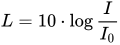
The sound intensity level in bels is defined by the decimal logarithm of the ratio of the intensity I to a reference intensity I0, which is taken as the base (zero level):

respectively,
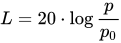
The sound intensity level can also be equivalently expressed using acoustic pressure and its threshold value p0:
Musical acoustics[edit | edit source]
Musical acoustics deals with sounds and their combinations with regard to the needs of music.
Tone[edit | edit source]
A tone is considered a sound with a constant frequency. The basic characteristics of a tone include:
- pitch (determined by frequency),
- loudness (determined by amplitude),
- duration,
- timbre (spectral composition of the sound).
Dissonance (two-tone sound / interval)[edit | edit source]
In music, a two-tone sound (interval) is the simultaneous sounding of two musical tones. These can be perceived as unpleasant (dissonant) or pleasant to the ear (consonant).
The pleasantness of two tones was already studied in the 6th century BC by Pythagoras through his experiments with strings, and around 300 BC by Euclid. Euclid claimed that two consonant tones have the ability to merge into a single whole, which is why we perceive them as harmonious, whereas dissonant tones do not have this property.
Two tones are considered consonant if their frequencies are in the ratio of small whole numbers not greater than 6. For example, two tones with a frequency ratio of 4:3 form a wave whose period equals three times the period of the lower tone and four times the period of the higher tone, which explains their consonance.
Interval[edit | edit source]
An interval is the pitch distance between two tones. Identical intervals always have the same ratio of the frequencies of the tones that form the interval. For example, the intervals between tones with frequencies 24 and 27 Hz and between tones with frequencies 32 and 36 Hz are the same, because the frequency ratio is 9:8 in both cases (a second).
| Interval | Frequency ratio |
|---|---|
| unison (prime) | 1 : 1 |
| second | 9 : 8 |
| third | 81 : 64 |
| fourth | 4 : 3 |
| fifth | 3 : 2 |
| sixth | 27 : 16 |
| seventh | 243 : 128 |
| octave | 2 : 1 |
Tuning[edit | edit source]
Just tuning uses only tones whose frequencies are in ratios expressible by whole numbers. Strict application of just tuning would lead to an infinitely large number of tones within an octave. When a limited number of tones is used, “impure,” less consonant intervals appear.
Moreover, the exact frequencies of individual tones differ across scales in just tuning (for example, the note A in C major does not have the same frequency as the note A in D major), which prevents its use in modulation or enharmonic substitution.
Therefore, equal temperament tuning was introduced. In this tuning, the octave is divided into 12 equal intervals determined by the frequency ratio 21/12, which represent the tempered semitone, whereas the just semitone is defined by the ratio 16:15.
Physiological acoustics[edit | edit source]
Physiological acoustics deals with the production of sound in the human vocal cords and its perception in the ear.
The human voice is produced in the vocal cords. These are two elastic membranes that are stretched during speech, creating a vocal slit between them. Air flowing from the lungs causes the vocal cords to vibrate, which produces sound waves.
Pitch of the voice depends on the length of the vocal cords and their tension, which can be adjusted by the action of the corresponding muscles. The pitch range of the human voice is approximately two octaves, although its position is individual. The timbre of the human voice arises from resonance in the laryngeal, oral, and nasal cavities.
The auditory organ consists of three parts – the outer ear, middle ear, and inner ear. The outer ear captures sound signals from the environment, and the middle ear transmits them to the inner ear. In the inner ear, auditory cells are stimulated and action potentials are generated, which are then transmitted to the brain.
The human auditory field is bounded by curves known as the threshold of pain (for a frequency of 1 kHz, the sound intensity level is about 120 dB) and the threshold of hearing (for a frequency of 1 kHz, the value is 0 dB).
The topic is discussed in more detail in the article Biophysics of hearing.
Among the clinical fields that use acoustics are otorhinolaryngology and phoniatrics. The use of ultrasound in medicine is covered in the article Ultrasound in various environments and tissues.

