Overview of Fungal Intoxication

According to the mechanism of mycotoxins, several syndromes are described. Differentiation of fungi is possible only by microscopic mycological examination from food residues or from the contents of the stomach or stool.
Gastroenterodyspeptic Syndrome
- Latency: < 2 hours
- Symptoms: gastrointestinal symptoms
- Toxins: unknown
- Treatment: symptomatic care
- Prognosis: good
- Notes: -
- Examples of fungi: Satan's bolete (Rubroboletus satanas), some members of the Agaricus genus and the Russula genus.
Muscarinic Syndrome
- Latency: < 2 hours
- Symptoms: sweating, salivation, lacrimation, miosis
- Toxins: muscarine
- Treatment: gastric irrigation, administration of atropine
- Prognosis: depends on the amount ingested
- Notes: -
- Examples of fungi: some members of the Inocybe genus and the Clitocybe genus.
Psylocibin Syndrome (psychotropic)
- Latency: < 2 hours
- Symptoms: hallucinations
- Toxins: psilocybin, psilocin
- Treatments: sedation, administration of diazepam
- Prognosis: good
- Notes: do not administer antibiotics
- Examples of fungi: fungi of Psilocybe genus
Mycoatropine-Neurotoxic Syndrome (muscarinic)
- Latency: < 3 hours
- Symptoms: muscarinic symptoms - sweating, lacrimation, miosis, convulsions, jaundice, diarrhea + other gastrointestinal symptoms → progress to anticholinergic symptoms - mental excitation, dryness of the skin, tachycardia, hallucinations, alternation between euphoria and depression...
- Toxins: muscimol, ibotenic acid, muscazone
- Treatment: gastric irrigation, oral administration of active charcoal, symptomatic care.
- Prognosis: relatively good
- Notes: do not administer diazepam, atropine, barbiturates
- Examples of fungi: fly agaric (Amanita muscaria) and panther cap (Amanita pantherina)
Gyromitrin-Hepatotoxic Syndrome
- Latency: 6–12 hours
- Symptoms: headache, convulsions, jaundice, diarrhea + other gastrointestinal symptoms
- Toxins: gyromitrin
- Treatment: gastric irrigation, oral administration of active charcoal, adjustment of metabolic acidosis, intravenous administration of pyridoxine, symptomatic cares
- Prognosis: uncertain
- Notes: intoxication is possible by inhalation
- Examples of fungi: Gyromitra esculenta
Phalloides-Hepatorenal Syndrome
- Latency: 6–24 hours
- Symptoms: gastrointestinal symptoms, hepatorenal failure
- Toxins: the amatoxin (thermostable cyclic octapeptides) amanitin and phaloidin
- Pathogenesis: toxins are taken up by the liver, and subsequently excreted inbile. The toxins are reabsorbed via the enterohepatic circulation. Once the toxins enter the cells, they bind to RNA polymerase, and inactivate it, causing a halt of proteosynthesis, → cell death
- Treatment: vomiting to remove toxin, gastric irrigation, massive dose of active charcoal (1g/kg/2-4 hours), administration of silibinin (inhibits the cellular uptake of amatoxins), hemodialysis/hemoperfusion, complex supportive care (fluid reimbursement, substitution of coagulation factors, glucose with insulin); the last treatment option is a liver transplantation.
- Prognosis: poor (death within a week from circulatory failure or septic shock), survival rate is 10-20%.
- Notes: 85% of amatoxins are excreted unchanged by kidneys. The kidney damage is caused by dehydration (during therapy it is necessary to maintain water and electrolyte balance)
- Examples of fungi: death caps (Amanita phalloides), fool's mushroom (Amanita verna, it is often confused with ones of Agaricus genus, parasol mushroom, St. George's mushroom)
Antabuse Syndrome
- Latency: 6–24 hours
- Symptoms: sweating, headache, tachycardia.
- Toxins: coprine
- Treatment: symptomatic care
- Prognosis: good
- Notes: symptoms occur only after the ingestion of alcohol
- Examples of fungi: common ink cap (Coprinopsis atramentaria)
Orellanine-Nephrotoxic Syndrome
- Latency: 36 hours –17 days
- Symptoms: gastrointestinal symptoms, headache, convulsions, oliguria, acute renal failure
- Toxins: orellanine
- Treatment: hemodialysis
- Prognosis: poor
- Notes: long latency!
- Examples of fungi: fool's webcap (Cortinarius orellanus)
-
 Boletus satanas − Satan's bolete
 -
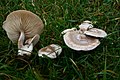 Clitocybe rivulosa − False champignon/Fool's funnel
 -
 Inocybe geophylla − Earthy inocybe
 -
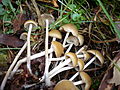 Psilocybe bohemica
 -
 Amanita muscaria − fly agaric
 -
 Amanita pantherina − Panther cap
 -
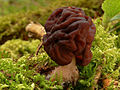 Gyromitra esculenta
 -
Amanita phalloides − Death cap
-
Coprinus atramentarius − Common ink cap
-
Cortinarius orellanus − Fool's webcap


References
Related articles
External links
- Otrava houbami— interaktivní algoritmus + test
- Otrava houbami – Wikipedie
- Otravy houbami – Toxikologické informační středisko]
Bibliography
- HAVRÁNEK, Jiří: Otrava houbami: Přehled intoxikace houbami
- BENEŠ, Jiří. Studijní materiály [online]. [cit. 24.02.2010]. <http://jirben.wz.cz>.


