Wave properties of particles, quantum properties of waves

Introduction
In classical physics, it was assumed that waves and particles were fundamentally different. Particles were described as stationary objects with mass, whilst waves were considered to be continuous oscillations in both space and time. Modern physics, particularly quantum mechanics, shows that both matter and radiation exhibit dual behaviour. This concept is known as wave-particle duality.[1]
Wave Properties of Particles
de Broglie Hypothesis
In 1924, Louis de Broglie proposed that every particle has an associated wavelength.
The de Broglie relation is given by:

Where:
- λ = wavelength
- h = Planck’s constant
- p = momentum
This hypothesis states that particles such as electrons can behave like waves under suitable conditions.[2]

Experimental Evidence
Electron Diffraction
The wave nature of electrons was confirmed in the Davisson–Germer experiment, where electrons scattered by a crystal produced an interference pattern.[3]

Double-Slit Experiment
In the double-slit experiment, particles such as electrons generate an interference pattern characteristic of waves. This demonstrates that particles behave as probability waves rather than classical objects.[4]
Implications
- Particles cannot be fully described using classical mechanics
- Their behavior is described probabilistically
- This leads to the formulation of the Schrödinger equation
Quantum Properties of Waves
Photon Concept
Although light is traditionally described as a wave, it consists of separate bundles of energy known as photons.
The energy of a photon is:

- E = energy
- ν = frequency
This relation shows that electromagnetic radiation is quantized.[5]

Photoelectric Effect
The photoelectric effect proves that light behaves like particles. Electrons are emitted from a metal surface only when the frequency of the incoming light exceeds a certain threshold.[6]
Compton Scattering
In Compton scattering, photons collide with electrons and change their wavelength in the process, proving that light carries momentum.[7]
Wave–Particle Duality
Wave–particle duality states that:
- Particles exhibit wave-like properties such as interference and diffraction
- Waves exhibit particle-like properties such as quantization
This principle is fundamental to Quantum theory.[8]
Heisenberg Uncertainty Principle
The Heisenberg uncertainty principle describes a fundamental limitation in measurement:
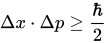
This means that position and momentum cannot be determined precisely at the same time.[9]
Wavefunction and Probability
In quantum mechanics, a particle is described by a wavefunction ψ. The probability of finding a particle within a certain range is given by:

The wavefunction itself is not directly observable, only its squared magnitude has physical meaning and corresponds to measurable outcomes. This interpretation, formulated by Max Born, marks a fundamental shift from the predictability of classical physics to the probabilistic character of quantum physics.[11]
References
- ↑ https://www.uni-muenster.de/Physik.AP/Demokritov/en/Forschen/Forschungsschwerpunkte/mBECwiwpd.html
- ↑ https://ethz.ch/content/dam/ethz/special-interest/chab/physical-chemistry/ultrafast-spectroscopy-dam/documents/lectures/allgemeinechemieHS21/Folien/ACPCI_HS21_W10.pdf
- ↑ http://physics.bu.edu/ulab/modern/Electron_Diffraction.pdf
- ↑ https://uni-tuebingen.de/fakultaeten/mathematisch-naturwissenschaftliche-fakultaet/fachbereiche/physik/institute/astronomie-und-astrophysik/astronomie-hea/forschung/abgeschlossene-projekte/detektorentwicklung/wt-dualismus/
- ↑ https://www.asc.ohio-state.edu/mathur.16/quantummechanics27-11-17/qm2.2/qm2.2.html
- ↑ https://homepage.univie.ac.at/reinhold.bertlmann/pdfs/T2_Skript_Ch_1corr.pdf
- ↑ https://www-users.york.ac.uk/~pjd113/notebooks/1_4_ComptonScattering.html
- ↑ https://www.monash.edu/student-academic-success/physics/wave-particle-duality
- ↑ https://www-users.york.ac.uk/~pjd113/markdown/1_6_HeisenbergUncertaintyPrinciple.html
- ↑ https://www.princeton.edu/~maelabs/mae324/glos324/wavefunction.htm
- ↑ https://www.dalalinstitute.com/wp-content/uploads/Books/A-Textbook-of-Physical-Chemistry-Volume-1/ATOPCV1-1-3-Max-Born-Interpretation-of-Wave-Functions.pdf

