Ventilation

Tidal volume, Respiratory rate and Dead space
- Tidal volume: Is called the amount of air inhaled or exhaled during one quiet breath during resting conditions. It's average value accounts for 500ml of air per breath
- Respiratory rate: Is called the number of breaths taken per unit time. It's average value accounts for 12 breaths per minute
- Dead space: Is called the amount of air that enters the lung airways that do not participate in the gas exchange process. It's average value accounts for 150ml of air per breath

Ventilation
Is the called the amount of air entering the respiratory airways per unit time. Usually it is measured in liters per minutes. The ventilation can be divided into three categories according to the anatomical and functional properties of the lung airways:
- Minute Ventilation
- Alveolar Ventilation
- Dead Space Ventilation


Minute ventilation
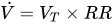
Minute ventilation is the total volume of air that enters the lungs per minute
- Minute ventilation (ml/min) = Tidal volume (ml/breath) × Respiratory rate (breath/min)
Alveolar ventilation
Alveolar ventilation is the volume of air per unit time that reaches the alveoli, the respiratory portions of the lungs where gas exchange occurs
- Alveolar ventilation (ml/min) = [Tidal volume (ml/breath)-Dead space (ml/breath)] × Respiratory rate (breath/min)

Dead space ventilation
Dead space ventilation is the volume of air that enters the lung airways that do not participate in the gas exchange process per minute
- Dead space ventilation (ml/min) = Dead space (ml/breath) × Respiratory rate (breath/min)

Ventilation Values
| Measure | Resting conditions |
|---|---|
| Minute ventilation | 6 L/min |
| Alveolar ventilation | 4.2 L/min |
| Dead space ventilation | 1.8 L/min |
| Tidal volume | 500 ml |
| Respiratory rate | 12 breaths/minute |
| Dead space | 150ml |
Links
Bibliography
- HALL, John E. – GUYTON, Arthur C. Guyton and Hall Textbook of Medical Physiology. 12. edition. Saunders/Elsevier, 2010. ISBN 1416045740.
- Lecture Notes: Prof. MUDr. Jaroslav Pokorný DrSc.

