Interference of light

Interference of light means the mutual influence, collision or intermingling of light waves. This phenomenon confirms the wave nature of light, and its properties thus resemble mechanical waves.
Emergence
Light interference is mainly observed in monochromatic radiation. What is important above all is that the waves strengthen each other in some places of collision and weaken in others, thus changes in the intensity of light occur. By stacking light waves, an interference pattern (structure) is created, which is only observable if both waves are mutually coherent. Waves are called coherent if they have the same frequency and their phase difference does not change at a given location (it is constant). With ordinary light sources (the Sun, a light bulb, a flame), interference cannot be observed because it is an incoherent wave. The light emitted by these sources is the result of chaotic waves of different frequencies.
Basic Features

For light waves:
and


- λ0 = wavelength of light in vacuum
- c = speed of light in vacuum
- n = refractive index of environment
- λ = wavelength of light in a medium with refractive index n
- v = phase speed of light propagation
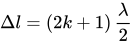
The result of light interference depends on the total path difference:
- the interference maximum occurs when the path difference is equal to an even number of half-waves

- the interference minimum occurs when the path difference is equal to an odd number of half-waves
Usage
An example of the practical use of light wave interference are interferometers that detect the intensity of two waves. We can also use light interference in the production of anti-reflective layers on the surface of lenses (camera, camera).
Newton glasses
Newton glasses consist of a glass plate and a plano-convex lens with a large radius of curvature. When monochromatic light hits the optical system, interference of the reflected light occurs and the formation of an interference pattern in the form of light and dark rings (Newton's rings). If we use white light, there will be bands of rainbow colors.

