Electric Injury

.jpg)
Electrical injury is a patho-physiological reaction caused by electric current passing through the body. Unlike mechanical trauma, the severity of electrical injury is determined by the complex interactions between physical parameters (voltage, current, resistance) and the biological properties of human tissues.
Physical Principles
The fundamental behavior of electricity in the body is governed by Ohm’s Law and Joule’s Law.
Ohm’s Law and Resistance
The amount of current () flowing through the body is determined by the potential difference () and the total electrical resistance () of the tissues:


The human body acts as a volume conductor. Different tissues offer varying levels of resistance:
- Low Resistance: Nerves, blood vessels, and muscles (high water and electrolyte content).
- High Resistance: Fat, bone, and dry skin.
Joule’s Law (Thermal Damage)
Most tissue damage in high-voltage injuries results from the conversion of electrical energy into thermal energy. This is described by Joule's Law:
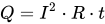
Where is the heat produced and is the duration of exposure. Because the heat produced is proportional to the square of the current, even small increases in amperage can lead to massive increases in tissue destruction.


Mechanisms of Tissue Damage
Electrical injury occurs through three primary biophysical mechanisms:
1. Thermal Heating
As current passes through tissues with resistance, temperatures can rise high enough to cause protein denaturation and coagulation necrosis. High-voltage current often follows the path of least resistance (neurovascular bundles), leading to "deep" burns where the skin may appear intact, but underlying muscle is destroyed.
2. Electroporation
Electroporation is a non-thermal mechanism where the strong electric field disrupts the cell membrane's lipid bilayer.
- Mechanism: The electric field creates a potential difference across the cell membrane. If this exceeds a critical threshold (typically ), the membrane's dielectric strength is overcome.
- Consequence: Formation of aqueous pores increases membrane permeability, leading to massive ion imbalances, cell swelling, and eventual apoptosis or necrosis.

3. Mechanical Trauma
High-voltage arcs can create "blast" effects or cause violent tetanic muscle contractions. These contractions are often strong enough to cause bone fractures or joint dislocations (commonly posterior shoulder dislocations).
Biological Factors
Current Type: AC vs. DC
- Alternating Current (AC): Typically 3–5 times more dangerous than Direct Current (DC) at the same voltage. AC causes tetany (sustained muscle contraction), which can cause a "freeze-on" effect where the victim cannot let go of the current source.
- Direct Current (DC): Tends to cause a single convulsive (sudden & violent) contraction that often throws the victim away from the source.
The Path of the Current
The "source-to-ground" path determines which organs are at risk:
- Transthoracic: Current passing through the chest is most likely to cause fatal cardiac arrhythmias (e.g., ventricular fibrillation) or respiratory arrest.
- Transcranial: Can lead to immediate unconsciousness, respiratory depression, or long-term neurological deficits.
Burns

The thermal manifestations of electrical injury are unique among burn traumas due to the disparity between visible surface damage and internal tissue destruction. In electrical trauma, the body acts as a volume conductor, converting electrical energy into thermal energy () as the current traverses internal structures.
Cutaneous Burn Types
The skin, specifically the stratum corneum, provides the primary resistance to electrical flow. Once this resistance is overcome—either by high voltage or moisture—several types of burns can manifest:
- Contact Burns: These occur at the entry and exit points of the current. They are typically characterized by a "bull's-eye" appearance: a central charred area of necrotic (dead) tissue, surrounded by a middle zone of greyish-white coagulation, and an outer ring of red, inflamed skin (erythema).
- Arc Burns: These occur when an electric current "jumps" from a high-potential source to the body through the air. Because an electric arc can reach temperatures up to 2,500°C to 5,000°C, these can cause extreme, localized charring and deep tissue destruction in a fraction of a second.
- Flame Burns: Electricity can ignite a victim's clothing or nearby flammable materials, leading to traditional thermal flame burns that may occur simultaneously with the electrical injury.
- Flash Burns: Resulting from the intense light and heat of an arc flash, these are usually superficial or partial-thickness burns on exposed skin surfaces, similar to a severe sunburn but occurring instantly.
Pathophysiology of "Internal" Burns
High-voltage injuries (>1,000 Volts) often lead to extensive deep-tissue necrosis that is not immediately apparent.
- Thermal Sequestration: Because bone has high resistance, it generates significant heat when current passes near it. This heat is then conducted to the surrounding deep muscle, effectively "cooking" the limb from the inside out.
- The "Freeze-on" Effect: As noted in Ohm's Law, the duration of exposure (t) is a critical factor in heat production. At levels above the "let-go" threshold (approx. 10mA), involuntary muscle contraction prevents the victim from releasing the source, exponentially increasing the Joule heating and the depth of the resulting burn.
- Vascular Thrombosis: The heat often damages the endothelial lining of blood vessels. This can lead to delayed blood clotting (thrombosis) and nutrient deprivation in tissues that were not directly burned, often necessitating surgical intervention or amputation days after the initial injury.
Classification of Severity
Unlike standard thermal burns, which are classified by the percentage of Total Body Surface Area (TBSA), electrical burns are often classified by the voltage of the source:
| Voltage Level | Primary Burn Mechanism | Clinical Characteristic |
| Low Voltage (<1,000 Volts) | Contact / Resistance | Localized, often "entry/exit" points; risk of VF. |
| High Voltage (>1,000 Volts) | Joule Heating / Arc | Deep muscle necrosis; high risk of limb loss. |
| Lightning Strikes | Flashover | Superficial "Lichtenberg" feathering; rarely causes deep burns. |
Note on Dielectric Breakdown: If the voltage exceeds 450–600 V, the skin undergoes dielectric breakdown, where its resistive properties are punctured. This causes a sudden drop in resistance (R), leading to a massive spike in current (I) and catastrophic internal thermal energy release.
Symptoms and Pathophysiology
The clinical manifestations of electrical injury are a direct result of the biophysical disruption of cellular homeostasis. Because electricity follows the path of least resistance, internal damage often far exceeds visible cutaneous markers.
Cardiac Dysrhythmias
The heart is highly susceptible to external electrical fields because its function relies on precisely timed endogenous electrical impulses.
- Ventricular Fibrillation (VF): This is the primary cause of immediate death in low-voltage AC injuries. A 60 Hz current as low as 30 mA can induce VF if applied for longer than one second. The heart muscle fibers begin to move independently, ceasing the coordinated action required for the cardiac cycle.
- Asystole: More common in high-voltage DC or lightning strikes. A massive singular depolarization causes the entire myocardium to contract simultaneously and then stop.
- Microshock: If the skin is bypassed (e.g., via a cardiac catheter), currents as low as 10 μA can trigger fatal fibrillation, as the protective resistance of the stratum corneum is removed.
- Mechanism of Arrhythmia: Biopsies suggest that electrical injury creates "patchy myocardial fibrosis" and disrupts the sodium-potassium () pumps, leading to localized changes in membrane potential and the creation of arrhythmogenic foci.

Neuromuscular Effects
The nervous system has the lowest resistance of all human tissues, making it an ideal conductor for current.
- The "Let-Go" Threshold: At approximately 10 mA (AC), the current causes involuntary tetanic contraction of the muscles. Because flexors are generally stronger than extensors, a victim may be physically unable to release an electrified wire, leading to prolonged exposure and deeper burns.
- Neuropathy: Neurological symptoms can be immediate or delayed by days or years. Delayed consequences, such as progressive demyelination, often carry a worse prognosis.
- Cerebral Effects: Current passing through the head often results in immediate loss of consciousness. If VF occurs, secondary cerebral hypoxia (lack of oxygen to the brain) can lead to permanent cognitive deficits.
Thermal Injury and Arc-Flash
Thermal damage occurs through both direct contact and "arcing."
- Joule Heating: In high-energy trauma, the heat generated () in deeper tissues along an extremity can reach damaging temperatures in seconds. This often causes "internal burns" even when the skin appears relatively intact.
- Arc-Flash Hazards: Approximately 80% of electrical injuries involve arcing faults. An arc flash produces intense light radiation and temperatures high enough to vaporize metal. This "arc blast" can produce mechanical pressure waves capable of breaking bones and damaging internal organs.
- Electroporation: Independent of heat, high-voltage fields can physically tear holes in cell membranes (electroporation), leading to cell death through ion imbalance.

Musculoskeletal and Renal Complications
- Compartment Syndrome: Heat-induced edema within the rigid fascia of muscle groups increases pressure, which can cut off blood flow to a limb.
- Rhabdomyolysis and AKI: Massive muscle necrosis releases myoglobin into the bloodstream. The kidneys attempt to filter these large molecules, which can lead to mechanical obstruction of the renal tubules and Acute Kidney Injury (AKI), often signaled by dark, "tea-colored" urine.
Mental Health and Long-term Effects
Electrical injury frequently results in significant psychiatric morbidity, even if the current did not pass through the brain. Common symptoms include:
- Anxiety Spectrum Disorders: Particularly Post-Traumatic Stress Disorder (PTSD) and a specific fear of electricity.
- Cognitive Impairment: Difficulty learning, decreased attention span, and memory loss.
- Behavioral Changes: Depression, lower frustration thresholds, and irritability.
Comparison of Human Sensitivity to Current
| Current (60 Hz AC) | Physiological Effect |
| 1 mA | Threshold of perception |
| 10 mA | "Let-go" threshold (tetanic muscle contraction) |
| 30 mA | Threshold for Ventricular Fibrillation (chest path) |
| >600 V | Dielectric breakdown of the skin |

